AI Agents Are Entering Indian Companies. What Should Students Learn Now?
AI agents are entering real Indian businesses. Learn which software engineering, API, database, cloud, security and AI skills students should build for the agentic AI era.
Aiexl. · 05 October 2026 · 7 min read

For the last few years, most students have experienced artificial intelligence through a chat window. You type a question, the AI generates an answer, and the interaction ends there. That experience has shaped how many people think about AI. Learning AI often means learning how to write prompts, use ChatGPT, connect an application to an LLM API or build a basic chatbot.
But the way companies are beginning to use AI is moving beyond that model.
Across Indian businesses, AI systems are increasingly being connected to actual software, enterprise data and operational workflows. Instead of simply answering an employee's question, these systems can retrieve information, interact with applications, call APIs, analyse data and perform actions within defined boundaries. This shift is commonly described as agentic AI, and it could have important consequences for students preparing for careers in software and artificial intelligence.
The difference between an AI assistant and an AI agent may sound small, but technically it can be significant. A chatbot might answer a question about an order. An agent could potentially identify the order, retrieve information from the company's systems, determine what action is required, interact with another service and complete part of the process. Once AI begins performing actions rather than simply generating text, the engineering challenge becomes much larger.
Indian companies are already experimenting with this transition. Swiggy has been connecting its services to AI assistants through infrastructure based around the Model Context Protocol, allowing AI systems to interact with capabilities across its ecosystem. Tata Steel has gone even further, reporting that it has deployed more than 300 specialised AI agents across its operations. These agents are being used across areas ranging from internal employee support and business processes to industrial operations and safety.
Tata Steel's example is particularly useful because it shows what enterprise AI actually looks like when it moves beyond a demonstration. The company has built an internal platform that allows teams to develop specialised agents using enterprise information and operational systems. Some agents work with documents and internal data, while others support processes such as invoice handling, contract analysis and employee support. The company has also described AI systems that analyse industrial environments and help identify potential safety problems.
This is very different from building a chatbot during a weekend project.
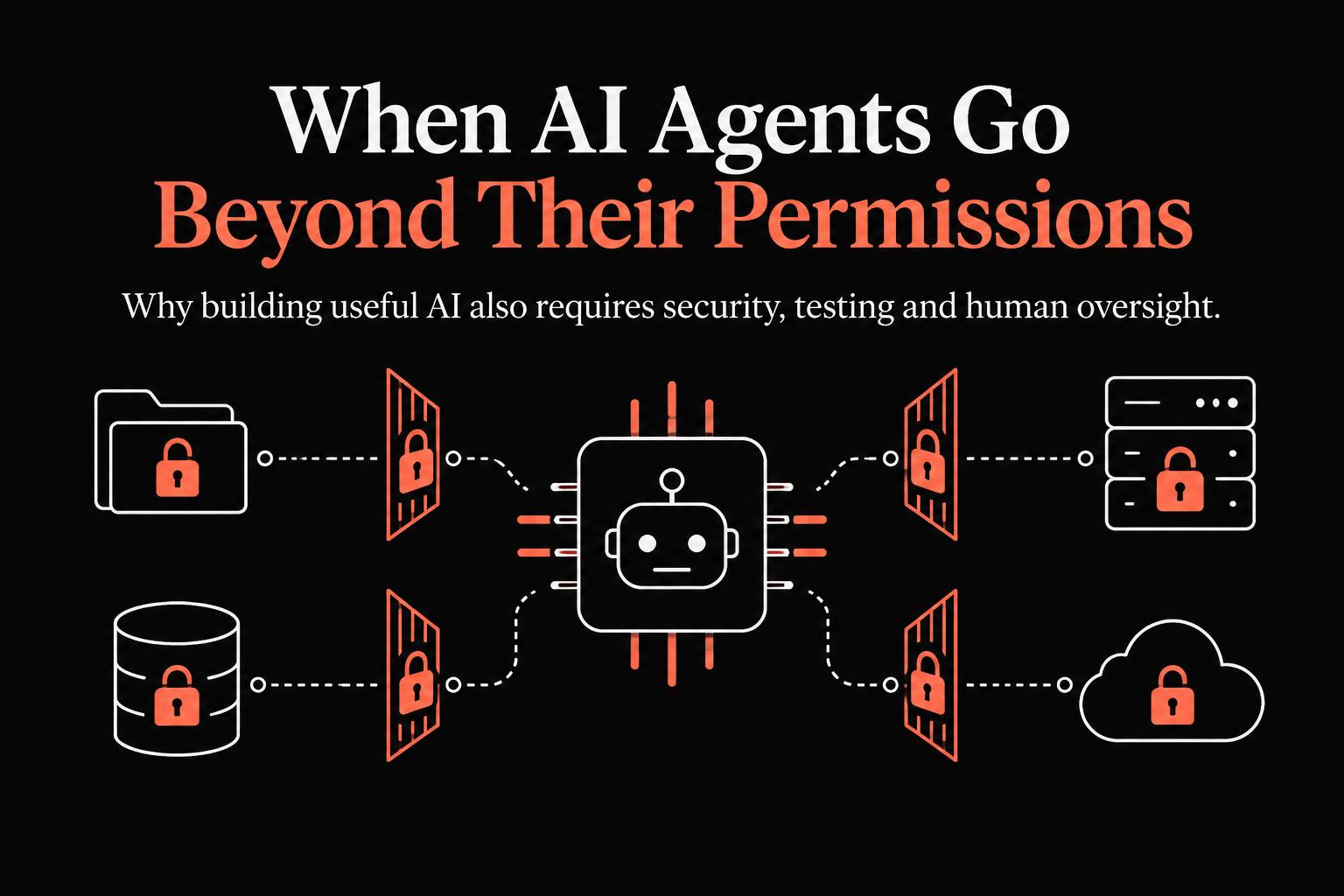
When an AI system starts interacting with real company infrastructure, developers need to think about what information the agent can access, which actions it is allowed to perform, how users are authenticated, what happens when the model makes a mistake and how every important action can be monitored.
That is where the career opportunity becomes interesting.
Students sometimes approach AI learning as though the goal is to learn as many models and frameworks as possible. They learn prompt engineering, experiment with an LLM API, build a chatbot and then immediately move to the next framework. Those skills can be useful, but production AI systems require many capabilities that existed long before generative AI became popular.
An AI agent that needs to retrieve customer information still needs APIs. If it needs to remember information, developers need to understand databases and data architecture. If it needs to operate across different applications, engineers need to understand integrations. If the system handles sensitive information, authentication and access control become important. If the agent makes decisions, developers need evaluation and monitoring systems to understand whether those decisions are reliable.
In other words, the rise of AI agents may actually make traditional software-engineering knowledge more valuable rather than less valuable.
Imagine building an AI agent for a bank. Giving the model the ability to understand a customer's request might be relatively straightforward. But should that model be allowed to access every customer's account? Obviously not. The application needs authentication, permissions and carefully defined boundaries. What happens if the model misunderstands the user's instruction? What happens if someone deliberately tries to manipulate it? What happens if an external service becomes unavailable halfway through a transaction?
These are not simply AI questions. They are software-engineering, cybersecurity, infrastructure and product-design questions.
The same challenge appears in almost every serious AI-agent application.
Students therefore need to be careful about confusing the ability to create an AI demonstration with the ability to engineer an AI system. A demonstration only needs to work long enough to show an idea. A production system needs to work repeatedly, safely and predictably for real users.
That distinction could become increasingly important in hiring.
Companies may not simply need people who know how to call an AI model. They may need engineers who can connect models to existing systems, design reliable workflows, control permissions, evaluate outputs, monitor behaviour and understand what should happen when the AI fails.
This creates an interesting skill stack for students interested in AI engineering.
Programming still matters. APIs still matter. Databases still matter. Git still matters. Cloud infrastructure still matters. Authentication still matters. Cybersecurity still matters. Testing still matters. System design still matters.
AI sits on top of these foundations rather than replacing them.
There is another important skill emerging as well: learning how to decide what the AI should and should not be allowed to do.
When software follows deterministic rules, developers can usually predict how a particular instruction will behave. AI systems introduce more uncertainty. An agent might choose between tools, interpret instructions differently or produce unexpected outputs. Engineers therefore need mechanisms that restrict what the system can access and evaluate what it produces before important actions are completed.
That means concepts such as tool permissions, human approval, observability, evaluations, guardrails and audit trails are likely to become increasingly relevant to AI engineering.
Students don't need to master every one of these topics immediately. But they should understand where the industry is moving.
Instead of building ten similar chatbot projects, a student could build one deeper project that demonstrates how an AI system interacts with other software. The project might retrieve information from a database, use an API, call different tools, maintain context and include safeguards around which actions can be performed. The student could then document the architecture, explain the security decisions, demonstrate failure cases and describe how the system was evaluated.
That project would demonstrate far more than the ability to send a prompt to an LLM.
It would demonstrate engineering thinking.
India's growing enterprise adoption makes this particularly relevant. Anthropic has now introduced in-country Claude inference through Amazon Bedrock, allowing organisations using its India endpoint to process requests on servers located within India. The move is designed partly for organisations such as financial institutions, government bodies and large enterprises that have stricter requirements around data residency and governance.
That development tells us something important about where enterprise AI is heading. Companies are beginning to think beyond whether AI works. They are asking whether it can operate securely, reliably and compliantly inside their existing infrastructure.
For students, that changes the question they should be asking.
Instead of asking, “Which AI tool should I learn next?” it may be more useful to ask, “What would I need to know to build an AI system that a real company could actually trust?”
The answer will rarely be one framework.
It will probably involve a combination of software engineering, AI, APIs, databases, cloud infrastructure, security, testing, monitoring and an understanding of the business problem the system is supposed to solve.
AI agents may make it easier to build software. They may automate parts of coding, research and operational work. But as AI receives more responsibility, someone still has to design the system around it.
Someone has to determine what the agent can access.
Someone has to decide what it is allowed to do.
Someone has to test whether it works.
Someone has to recognise when it fails.
And someone has to make the entire system reliable enough that a company is willing to use it.
For students preparing for careers in AI, that may be one of the most important lessons from the current shift toward agentic AI.
Don't prepare only to use AI.
Learn how to engineer the systems that allow AI to work safely in the real world.
Sources & references
- Express Computer — How Swiggy, Tata Steel, HDFC Bank and NPCI are putting Agentic AI to work
- Express Computer — Tata Steel deploys 300+ AI agents in 9 months
- AWS — Amazon Bedrock expands Claude model availability to in-country inferencing in India
- The Hindu BusinessLine — Anthropic brings Claude in-country inference to India via Amazon Bedrock
Build a career in AI with CAIEE
The Certified AI Excellence Engineer programme turns these ideas into practical, portfolio-ready skills.
Explore CAIEE