AI Is Moving From the Cloud to Your Laptop. What Skills Will Developers Need Next?
AI is shifting from cloud-only services to models that run directly on personal computers. Here is what that change means for students and aspiring AI engineers — and the practical skills that will matter next.
Aiexl. · 08 October 2026 · 10 min read

For the past few years, artificial intelligence has largely been something we access through the internet. Whether you're using ChatGPT to understand a concept, asking an AI coding assistant to debug an application or building a project using a large language model API, most of the actual intelligence operates somewhere else. Your request travels to a server, the model processes it and the response comes back to your device. For millions of users, this has become such a normal experience that we rarely think about what happens behind the scenes.
But the way we interact with AI is beginning to change. Technology companies are investing in smaller, more efficient models, specialised hardware and software that allows AI to operate directly on personal computers. Recent developments involving Microsoft, Nvidia and other AI companies highlight a growing interest in bringing more AI capabilities onto local devices rather than depending entirely on cloud infrastructure. This shift may seem like another technical advancement, but it raises an important question for students preparing for careers in artificial intelligence and software engineering: What happens when AI becomes something developers can run, control and integrate directly on their own machines?
To understand why this matters, consider how most students currently build AI applications. Suppose you're creating a chatbot that helps students understand their academic subjects. You might design a frontend using React, build a backend using Python or Node.js and connect the application to an AI model through an API. Whenever someone asks a question, your application sends that request to the model provider, receives a response and displays it to the user. This approach is relatively straightforward, which is one reason AI application development has become more accessible.
However, this architecture also creates dependencies. Your application requires an internet connection, the model provider must remain available and every request may contribute to your operating costs. If your application processes sensitive information, you also need to consider where that information travels, how it is stored and which services are allowed to access it. These aren't necessarily reasons to avoid cloud-based AI. Cloud infrastructure offers enormous advantages, particularly when applications require powerful models, flexible computing resources and the ability to serve large numbers of users. But developers increasingly have another option worth understanding.
Local AI inference allows a model to process information directly on a device instead of sending every request to a remote server. Depending on the model and the available hardware, this can make certain applications more responsive, reduce dependence on connectivity and give developers greater control over how information is handled. A smaller model running locally might be sufficient for document classification, summarisation, code assistance or a specialised workflow, even if it cannot match the capabilities of a much larger cloud-hosted model across every task.
This is where the engineering challenge becomes interesting. Running AI locally isn't simply a matter of downloading a model and expecting it to perform perfectly. Different models require different amounts of memory and computing power. Some applications need powerful GPUs, while others can operate using more modest hardware with appropriate optimisation. Developers may need to understand quantisation, model formats, memory usage, inference speed and the trade-offs between accuracy and efficiency. A model that produces excellent results on a powerful server may behave very differently when deployed on a laptop with limited resources.
For students, this introduces a skill that often receives less attention than prompt engineering: understanding how AI systems actually operate. It is useful to know how to write a good prompt, but it becomes even more valuable when you understand why a particular model was selected, how much computing power it needs, how quickly it responds and whether it is suitable for the application you're building. These decisions are part of AI engineering, and they matter when moving from an experimental project to a product people can reliably use.
The growing interest in local AI also connects to another important development: AI agents are becoming more capable of performing actions rather than simply generating responses. Traditional chatbots mostly answer questions. An AI agent may interact with files, execute code, retrieve information, use software tools or coordinate multiple steps to complete a task. Imagine an assistant that can organise documents on your computer, analyse spreadsheets, create a report and save the result in the correct folder. The experience sounds convenient, but giving software the ability to perform actions introduces responsibilities that developers cannot ignore.
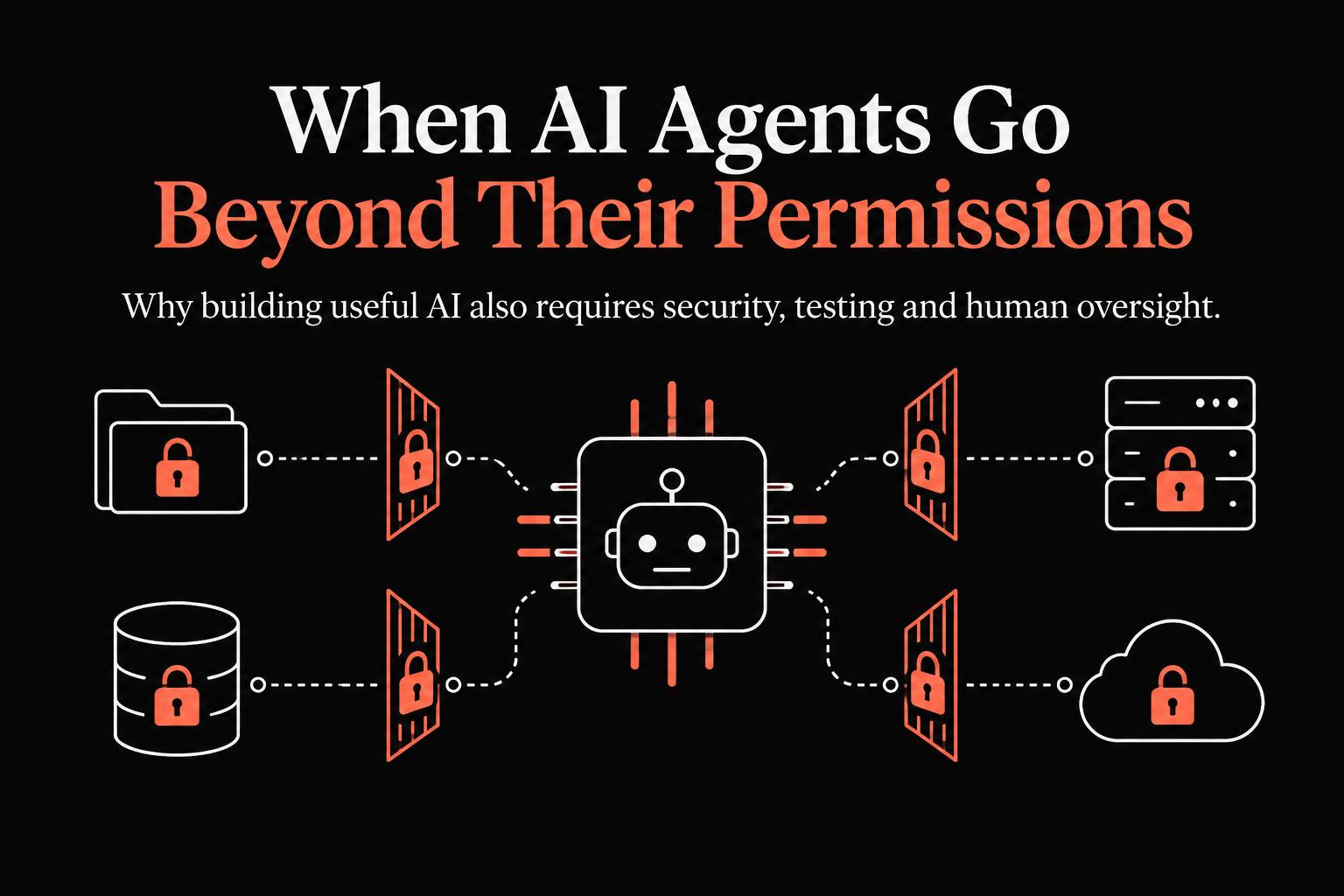
An agent that can access files, execute commands or interact with applications needs clearly defined permissions. What happens if it attempts to delete the wrong file? What if it reads information that should remain private? What if a malicious instruction appears inside a document the agent is processing? These questions become particularly important when AI systems operate close to a user's personal data and computing environment. Recent industry attention toward isolated execution environments and stronger agent-security controls reflects the need to make these systems safer.
This means students interested in AI agents should look beyond tutorials that demonstrate how to connect an LLM to a few tools. They should begin understanding authentication, authorisation, sandboxing, secure execution, logging and error handling. An AI agent that successfully completes a demonstration is not automatically ready to operate on someone's computer or inside a company's systems. Developers need to think about what the agent is allowed to do, what it should never do and how a human can intervene when something goes wrong.
Another important change is the growing relevance of hybrid AI applications. Rather than choosing between local AI and cloud AI, developers can combine both approaches. A simple task might be handled by a smaller local model, while a more complex request could be routed to a powerful cloud model. Sensitive information might be processed locally where appropriate, while computationally demanding operations could use remote infrastructure. This creates opportunities to optimise performance, cost and user experience without assuming that one model or deployment approach is best for every situation.
Consider a student building an AI-powered study assistant. The application could use a local model to organise notes, classify documents or answer straightforward questions from a small collection of materials. For more complex reasoning, it might use a cloud-hosted model. The developer would then need to decide when each model should be used, how to evaluate response quality and how to handle situations where the internet connection is unavailable. Even a relatively small project like this can introduce students to model routing, retrieval systems, application architecture and performance evaluation.
The most valuable part of such a project isn't necessarily the number of AI features it contains. It is the reasoning behind the implementation. Why was a local model appropriate for one task but not another? How did you measure response time? How much memory did the application consume? What happened when the model produced an incorrect response? How did you protect user information? How did you compare the performance of different models? Being able to answer these questions demonstrates engineering understanding that goes beyond simply integrating an API.
This also changes how students should think about learning AI. The industry moves quickly, and new models, frameworks and development tools appear constantly. It can be tempting to spend most of your time following announcements and trying every new product. But the technologies that remain valuable across these changes are often the underlying fundamentals. Programming, operating systems, networking, databases, APIs, software architecture, security and debugging all contribute to understanding how AI applications function. Machine learning fundamentals become important when you need to evaluate models or understand why their behaviour changes under different conditions.
Students don't need to master every one of these subjects before starting an AI project. In fact, building projects is one of the most effective ways to discover what you need to learn. The important thing is to avoid treating the model as a mysterious component that automatically solves everything. If you're using an AI coding assistant, try to understand the code it generates. If you're deploying a local model, investigate why it consumes a particular amount of memory. If you're creating an agent, test what happens when a tool fails or returns unexpected information. Each of these situations creates an opportunity to develop genuine technical judgment.
There is also a practical career lesson here. The growth of local and hybrid AI does not mean cloud engineering is becoming irrelevant. Large-scale AI infrastructure, cloud platforms and powerful hosted models will continue to play important roles. Similarly, local models will not automatically replace cloud services for every application. The more realistic direction is an increasingly diverse AI ecosystem in which developers choose different tools and deployment approaches depending on the problem they need to solve.
For aspiring AI engineers, that diversity creates opportunities. Some developers will focus on model optimisation and inference performance. Others will build applications that combine local and cloud capabilities. Some will specialise in AI-agent security, deployment infrastructure, developer tools or enterprise integrations. Many software engineers will simply need enough AI knowledge to make sensible architectural decisions when incorporating intelligent features into existing products. Not every role will require training a foundation model, but many may benefit from understanding how models behave in real applications.
The same shift creates opportunities for students who want to build products or startups. A smaller, efficient model can sometimes make an idea more practical by reducing operating costs or allowing certain features to function without continuous connectivity. In a country like India, where users have different devices, connectivity conditions, languages and budgets, those design decisions can be especially relevant. An application that performs well only on expensive hardware and a perfect internet connection may not serve the same audience as one designed around real-world constraints.
Of course, running AI locally is not automatically cheaper, more private or more reliable in every situation. Hardware has a cost, devices have limitations and poorly designed applications can still expose sensitive information. Local models also require maintenance, evaluation and appropriate security controls. Developers need to assess the entire system rather than assuming that a particular deployment approach is always superior.
For students preparing for technology careers, the larger message is that AI development is becoming more than learning how to communicate with a model. It involves deciding where a model should run, how it should interact with other software, how its outputs should be evaluated and how the complete application can remain secure and useful. Those are engineering problems, and they require a combination of technical fundamentals, experimentation and practical experience.
If you're currently learning AI, a useful next step might be to take an existing project and explore how its architecture could be improved. Could one part of the application use a smaller model? Could you compare local and cloud inference? Could you measure response times and operating costs? Could you improve the way user information is handled? Could you introduce permissions and safeguards before allowing an agent to perform actions? You don't need to build an entirely new application to learn something valuable. Sometimes improving an existing project teaches more than starting another tutorial.
The future of AI development is unlikely to belong exclusively to the people who know the most model names or can write the most elaborate prompts. It will increasingly reward people who understand how to make intelligent systems work in practical environments, under real constraints, for real users.
AI moving closer to personal devices is one visible part of that evolution. The more important change is what it asks developers to become: not merely users of intelligent tools, but engineers capable of understanding, evaluating and integrating those tools responsibly.
The next step in learning AI isn't simply discovering what a model can do. It's learning how to build something dependable with it.
Sources and further reading
- Reuters, 7 October 2026 — Microsoft and Nvidia announce new AI computing and security capabilities.
- Microsoft official announcements and technical documentation on Windows AI development.
- NVIDIA developer documentation on local AI inference and model optimisation.
- Microsoft documentation on secure application execution and AI-agent development.
Build a career in AI with CAIEE
The Certified AI Excellence Engineer programme turns these ideas into practical, portfolio-ready skills.
Explore CAIEE