Your AI Project Works. But Is It Ready for the Real World?
Building an AI application is only the beginning. Reliability, evaluation, deployment, monitoring, cost and security determine whether it is ready for real users.
Aiexl. · 23 September 2026 · 14 min read

Building an AI application has become surprisingly easy. A student can open a development environment, connect an API, write a few prompts, add a simple interface and have something working before the end of the day.
Modern AI development tools have reduced the technical barrier even further, allowing people to prototype applications in hours that might previously have required weeks of development. This is one of the most exciting changes happening in software development, because students can experiment with ideas much earlier in their learning journey.
But it has also created a new problem.
As getting something to work once becomes easier, it becomes increasingly tempting to confuse a working demonstration with a working system.
An AI application can perform beautifully when you demonstrate it to a friend and still struggle when real users begin interacting with it. A chatbot might answer ten carefully selected questions correctly but become unreliable when people phrase those questions differently. A retrieval system might find the correct document during development but return irrelevant information after the knowledge base becomes larger. An AI agent might successfully complete a workflow several times and then behave unexpectedly because one tool returned information in a format the developer had never encountered before.
The project technically “works,” but that does not necessarily mean it is reliable.
This distinction is becoming increasingly important for anyone learning AI engineering.
The first question students usually ask while building a project is, “Can I make this work?” That is a perfectly reasonable place to begin. But once the application starts working, another question becomes far more valuable: “Can I make this work reliably when I am no longer standing next to it?”
That question takes a project beyond experimentation and starts introducing the mindset required for production AI.
Imagine that you build an AI assistant that allows students to upload research papers and ask questions about them. You connect a language model, divide the documents into chunks, generate embeddings, store them in a vector database and retrieve relevant passages whenever someone asks a question.
You test the application by asking, “What is the main conclusion of this paper?” The answer looks excellent. You try another question and receive another convincing response.
From a learning perspective, this is already useful. You have probably learned something about APIs, embeddings, retrieval, vector databases, prompt construction and application development.
From an engineering perspective, however, you have mainly demonstrated that the system can work. You still do not know how reliably it works.
You do not know what happens when someone uploads a 300-page document, when two documents contain contradictory information, when the requested answer does not exist in the uploaded material or when the document contains tables and unusual formatting. You may not know how the system behaves when the retrieval layer finds a passage containing the correct keywords but the wrong meaning. You may also not know what happens when hundreds of users interact with the application, how much each request costs, how long responses take or what happens when an external service becomes unavailable.
These questions are sometimes treated as advanced concerns that can be considered later, but they are increasingly part of AI engineering itself.
Building the model interaction is only one part of building an AI system. The surrounding architecture determines whether the system can actually operate outside the controlled environment in which it was created.
Traditional software already requires developers to think about reliability, testing, infrastructure, security and failure. Generative AI introduces an additional layer of uncertainty because the output itself can be probabilistic. An application may technically operate exactly as designed while still producing an incorrect or misleading result.
Consider an AI-powered resume assistant. The user uploads a resume, the server processes the file correctly, the model receives the information and the response appears on the screen. Every software component may have functioned correctly. But if the AI recommends adding experience the candidate never had, the application has still failed from the user's perspective.
The software worked; the outcome did not.
This is one reason evaluation is becoming such an important part of AI development. Developers need ways to understand not only whether their application runs but whether the AI behaves as intended.
That becomes even more important when AI systems are allowed to perform actions rather than simply generate text.
A chatbot usually responds to a user. An AI agent may search information, query databases, call APIs, modify records, generate files or trigger actions in another application. Once AI can act, reliability stops being only a question of answer quality. It becomes a question of consequences.
Imagine an AI system designed to help a company manage customer-support requests. Instead of simply suggesting a response, the system can search customer records, review previous conversations, prepare a refund, update the CRM and draft an email.
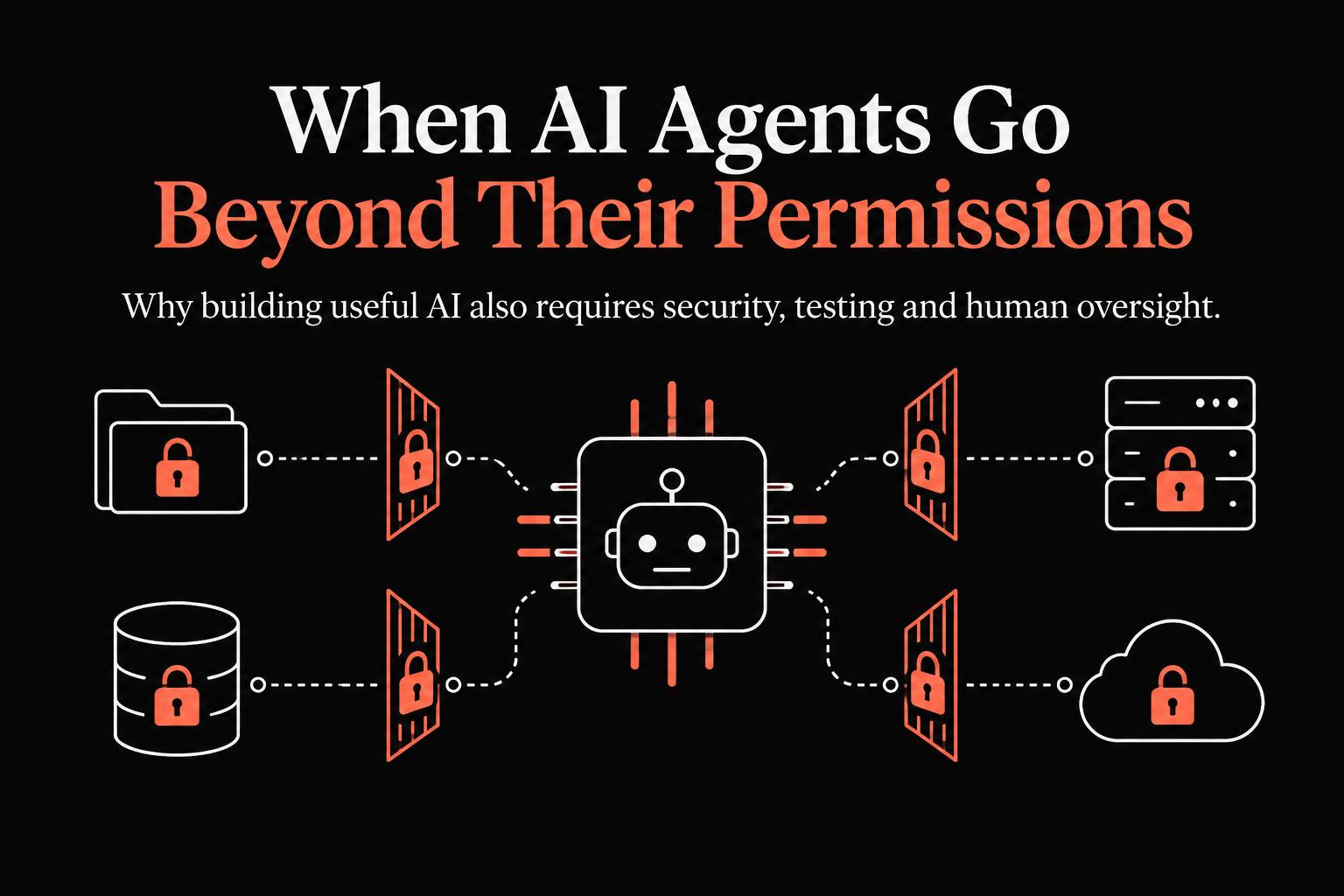
Giving the system access to those tools can make it dramatically more useful, but it also increases the importance of permissions and control. The AI may be allowed to search an account without being allowed to modify it. It might prepare a refund but require human approval before the refund is processed. It may draft an email but wait for confirmation before sending it.
Good AI engineering is therefore not about giving AI the maximum possible autonomy. It is about giving the system the appropriate amount of autonomy for the problem it is solving.
Evaluation also changes the way developers improve AI applications.
Students often test projects manually by asking several questions, reading the answers and deciding whether the application appears to work. This is useful during early experimentation, but it becomes difficult to know whether the system is genuinely improving.
Suppose you change a prompt and the first five answers look better. It is easy to assume that the new prompt improved the application. In reality, the change may have improved one type of query while making another type worse.
A stronger approach is to create representative test cases that can be reused whenever the system changes. A customer-support assistant, for example, could be tested against straightforward questions, ambiguous requests, missing information, conflicting information, unusual phrasing, sensitive requests and situations in which the AI should refuse to perform an action.
Instead of relying entirely on the feeling that “this version looks better,” developers can begin comparing behaviour across consistent scenarios.
The same principle applies to retrieval systems. Rather than only checking whether the final answer sounds convincing, developers can examine whether the correct information was retrieved, whether the answer is supported by that information and whether the system behaves appropriately when the required information does not exist.
This makes it possible to distinguish between different types of failure. Sometimes the language model is capable of answering correctly but receives the wrong context. Sometimes retrieval works but the prompt encourages the model to ignore important evidence. Sometimes both the model and retrieval system work correctly but the source information itself is outdated.
Without evaluation, all of these situations may simply look like “the AI gave a bad answer.”
With evaluation, developers can begin identifying where the system actually failed.
Context is another part of AI engineering that becomes much more important as applications become sophisticated.
Much of the early generative AI conversation focused on prompts, which created the impression that better instructions would solve most problems. Prompts remain important, but real AI applications often depend on far more information than the sentence immediately preceding the model's answer.
A model may receive system instructions, conversation history, retrieved documents, user preferences, application state, available tools and information from previous actions. All of that information competes for the model's attention.
Giving a model more context does not automatically make the application better.
Imagine asking someone to answer a question from a textbook. Giving them the three pages containing the relevant information might be helpful. Giving them 4,000 pages from twenty different textbooks may make the task considerably harder. AI systems face a similar problem.
The engineering challenge is not simply to collect as much information as possible but to decide what information the model needs, when it needs it and how that information should be structured.
Context therefore becomes part of the architecture rather than an unlimited storage space.
Even after solving these AI-specific problems, the application still has to survive ordinary software problems.
Databases fail. APIs time out. Authentication tokens expire. Users upload unsupported files. Networks become slow. External services experience outages. Model providers change behaviour. Applications encounter inputs their developers never anticipated.
AI does not remove traditional software-engineering problems; it adds new problems on top of them.
This is why students interested in AI engineering benefit enormously from learning ordinary software engineering. Understanding APIs, databases, authentication, error handling, Git, testing, deployment and logs may not appear as exciting as building a multi-agent application, but those foundations become extremely important when the application stops behaving as expected.
A person who understands only the AI model may struggle to diagnose a system-level failure, while someone who understands how the entire application fits together can investigate where the problem actually occurred.
The difference becomes even more visible after deployment.
During development, the creator controls most of the environment. They choose the questions, understand the intended workflow and know what the application is supposed to do.
Real users remove that comfort. They will ask questions the developer never considered, misunderstand parts of the interface, upload unusual information and use features in unexpected combinations. Some users may even deliberately test the boundaries of the system.
Deployment should therefore not be considered the end of an AI project. In many ways, it is the point at which developers begin discovering how the application behaves in reality.
They may find that one type of query consistently causes failures, that retrieval performs poorly on very short questions or that users abandon the application because responses take too long. A particular workflow may consume far more tokens than expected, or the model may frequently require information that the application is not providing.
Without monitoring, these patterns remain difficult to see. With monitoring, production itself becomes a source of information that helps improve the system.
The development process gradually becomes a continuous cycle in which the application is built, tested, deployed, observed, evaluated and improved.
This is a very different mindset from building something, recording a demonstration, uploading the repository to GitHub and immediately moving to the next project. The first approach develops engineering judgment because the developer has to understand how the system behaves over time rather than only during the successful demonstration.
Cost also becomes part of this engineering judgment.
Students can often build AI projects relatively cheaply because usage is small. Production applications operate under different conditions.
Imagine that one user request requires several model calls. Perhaps one model classifies the request, another processes retrieved information and a final model generates the response. With ten users, the difference may be insignificant. With ten thousand or one hundred thousand users, design decisions that seemed unimportant during development can become expensive.
This does not mean students need complicated financial models for every project. It simply means learning to think about resources.
Does every request require the most capable model? Could a smaller model handle one part of the workflow? Are you repeatedly sending information that could be cached? Is unnecessary context increasing token usage? Could one model call replace several?
These are engineering questions because engineering has always involved trade-offs.
The goal is not to build the most technologically complicated system possible. It is to build a system that solves the problem reliably with reasonable resources.
Security becomes another essential consideration when AI applications interact with private data or external tools.
Suppose an internal company assistant can search documents. A developer might initially focus on whether the retrieval system can find the correct information, but another question is equally important: should the person asking the question be allowed to retrieve that information at all?
An employee in one department may not have permission to access documents belonging to another. A customer should never be able to retrieve another customer's records. An AI agent capable of calling APIs should not automatically receive permission to call every available API.
These restrictions cannot depend entirely on the language model behaving responsibly. They need to exist in the architecture surrounding the model.
The more actions an AI system can perform, the more carefully its boundaries should be designed.
This is especially important as students begin experimenting with AI agents because the excitement of giving a system more tools can easily overshadow the responsibility that comes with those tools.
One of the simplest ways students can develop stronger engineering instincts is by deliberately trying to break their own projects.
Most project demonstrations focus naturally on the successful path. Upload the file, ask the question and watch the AI produce the expected answer.
But failures often teach far more.
Ask the system something it cannot know. Give it contradictory information. Provide an unsupported file. Make an external service unavailable. Try an ambiguous instruction. Attempt an action the user should not have permission to perform.
Then observe what happens.
Does the application crash? Does the model invent an answer? Does the system ask for clarification? Can it recover? Does it explain what went wrong? Does it know when it should stop rather than continue guessing?
Asking these questions changes the developer's mindset. Instead of thinking only about how to make the application work, they begin thinking about the different ways in which it could fail.
That is an important step toward engineering reliable systems.
The phrase “production-ready AI” can sound intimidating to students because it suggests expensive cloud infrastructure, sophisticated DevOps systems and millions of users.
None of those things are required to begin developing production thinking.
A student can take a basic RAG application and create twenty or thirty test questions. They can check whether the correct information is retrieved, add situations where the answer does not exist, measure response time, track approximate API usage, add basic logging and deploy the application.
Then they can give it to people who did not build it and observe how those users interact with it.
That project may still be relatively small, but it demonstrates something much more meaningful than familiarity with a framework. It demonstrates engineering thought.
The student has started considering reliability, users, evaluation, deployment and failure rather than simply whether the model can generate an impressive response.
This also changes what makes an AI portfolio impressive.
As AI-assisted development becomes more capable, creating basic applications will continue becoming easier. That is good for learners because the barrier to experimentation becomes lower, but it also means the existence of a simple AI application may communicate less about someone's ability than it once did.
The interesting questions begin moving deeper.
Why was the system designed this way? How was it evaluated? What failed during development? How was retrieval improved? How does the application handle missing information? What trade-offs were made? How are costs controlled? What can the AI access? What happens after deployment? What would need to change if the system suddenly had ten thousand users?
A student who can answer those questions demonstrates a much deeper understanding than someone who can only demonstrate that the application works.
This does not mean every portfolio project needs to resemble enterprise software. It means the person who built the project should understand the system beyond its successful path.
There will always be another AI framework, model, agent library, database or development tool promising to make AI applications easier to build.
Learning new tools is part of working in technology, but constantly moving between tools can create the illusion of progress without necessarily developing deeper understanding.
A more durable progression begins with learning how to build something, then understanding why it works, discovering how it fails, learning how to measure its performance, improving its reliability and eventually understanding how it behaves when other people begin using it.
That progression represents the difference between experimenting with AI and engineering with AI.
Students do not need to wait until they work inside a large technology company to start developing this mindset. They can begin with the project already sitting in their GitHub repository.
Instead of immediately adding another feature, they can open it again and try to break it. They can measure it, deploy it, give it to someone else, observe what happens and improve what fails.
An AI project that works during a demonstration is a good beginning.
An AI system that you understand well enough to evaluate, debug, explain and improve demonstrates something far more valuable: that you are beginning to think not simply as someone who can use AI, but as someone who understands how to engineer with it.