You Keep Learning AI, But Still Don't Feel Job-Ready. Here's What Might Be Missing
You have completed the courses, built tutorial projects and collected certificates, yet applying still feels out of reach. The missing step may be turning what you have learned into evidence you can demonstrate, explain and defend.
Aiexl. · 24 September 2026 · 13 min read
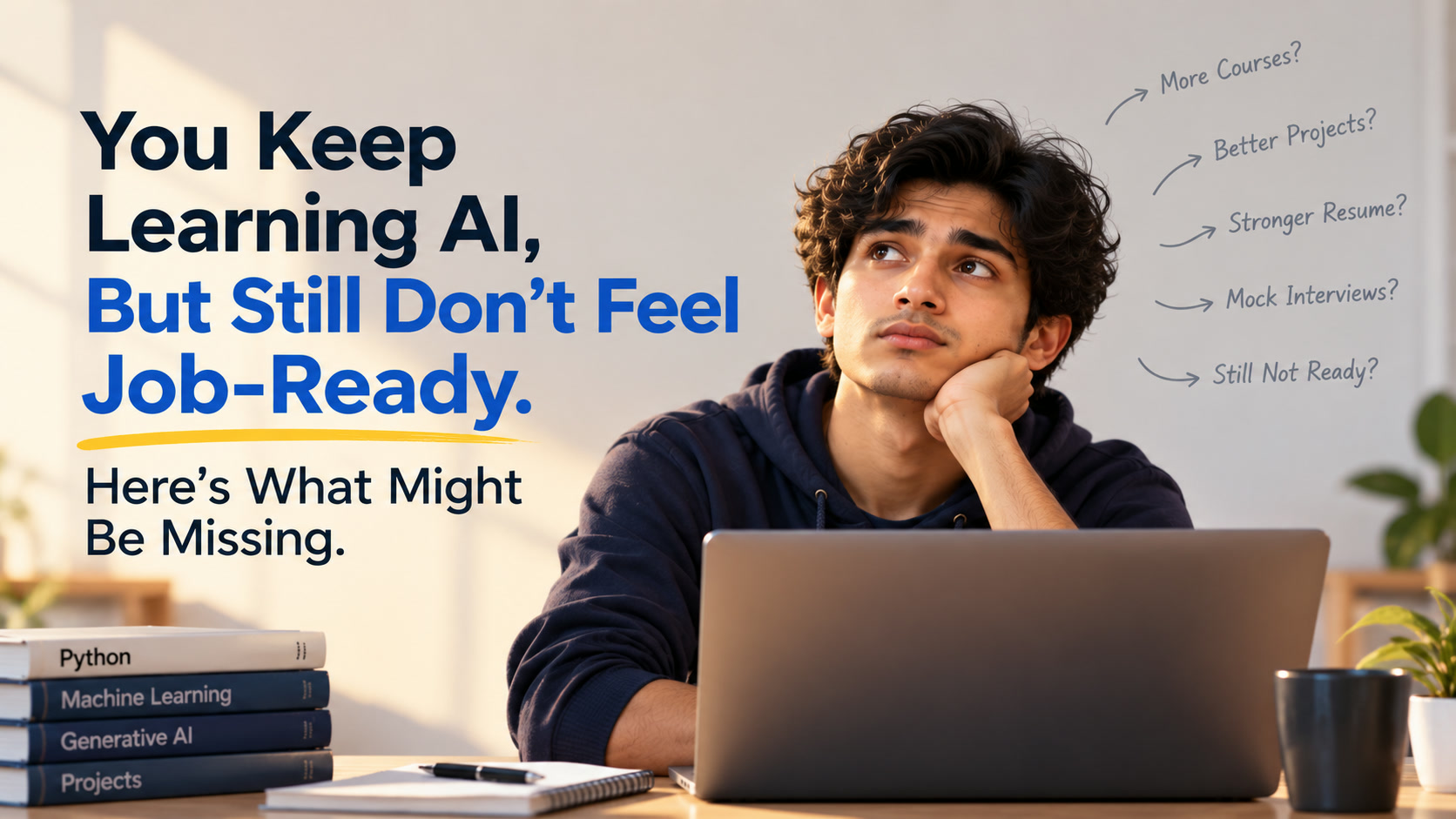
There is a strange stage in learning artificial intelligence that many students eventually reach. You have completed Python. You understand the basics of machine learning. You have watched tutorials on deep learning, explored generative AI, experimented with large language models and perhaps even built a few projects. Your LinkedIn profile has several certificates, your resume has a technical skills section, and your GitHub account contains repositories that did not exist six months ago.
Yet when you open a job description for an AI Engineer, Machine Learning Engineer or even an internship, you still hesitate before clicking Apply.
There is always something else in the requirements that you have not learned. One company mentions Docker. Another asks for AWS. Another expects SQL. Someone on LinkedIn says every AI engineer should know MLOps. A YouTube video tells you that RAG is essential. Another says AI agents are the future. Then you discover vector databases, LangChain, FastAPI, Kubernetes, system design, MCP and half a dozen other technologies that suddenly appear to be necessary.
So instead of applying, you go back to learning.
You take another course. Watch another playlist. Build another tutorial project. Add another technology to your roadmap.
A few months later, something interesting happens. Your list of skills is longer, but your confidence has barely changed.
You still don't feel ready.
This is one of the biggest traps students can fall into while preparing for technology careers. The problem is not always that they haven't learned enough. Sometimes they have never clearly defined what “job-ready” actually means.
If job readiness means knowing everything that could possibly appear in an AI job description, you will probably never feel ready. Artificial intelligence is simply moving too quickly. There will always be another framework, model, research paper, development tool or architecture that you haven't explored yet.
Career readiness therefore cannot mean reaching the end of AI.
There is no end.
It has to mean something more practical: reaching a point where you have enough relevant capability to begin competing for a particular kind of role and enough evidence to demonstrate that capability.
That distinction changes the entire way you prepare.
A common mistake students make is learning without first choosing what they are preparing for. They begin with Python because everyone recommends Python. Then they study machine learning because it seems like the natural next step. Then deep learning appears important. Then generative AI becomes popular, so they move there. Then AI agents start trending and another framework enters the learning plan.
None of those subjects is necessarily a bad choice. The problem is that the learning journey has no destination.
Imagine opening Google Maps and asking it to show you the best route without entering where you want to go. There is no meaningful answer. The shortest route depends entirely on the destination.
Career preparation works the same way.
Someone preparing for a Data Analyst role does not need exactly the same portfolio as someone targeting AI Engineering. A student interested in Machine Learning Engineering needs a different balance of skills from someone interested in software development. Even two AI roles can have very different expectations depending on the company and the product.
Before asking, “What should I learn next?” it is therefore worth asking a more important question: “Which type of problem do I want to become capable of solving?”
Once you have a target role, job descriptions become much more useful. Instead of reading one description and panicking because it contains fifteen technologies, study twenty or thirty relevant roles. Look for patterns.
You may discover that Python appears almost everywhere. SQL appears frequently. Git is commonly expected. APIs and software-development fundamentals appear repeatedly. Certain AI roles consistently mention machine learning, LLMs, RAG or cloud platforms. Other technologies appear only occasionally.
Now you have something much more useful than a random online roadmap. You have a picture of what employers repeatedly expect for the type of role you are considering.
You still do not need to match every requirement before applying.
Job descriptions often describe an ideal candidate rather than a minimum human being allowed to submit an application. If you wait until you satisfy every line perfectly, you may spend months preparing for a standard that even many applicants with experience would not match exactly.
The better question is whether you understand the core capabilities of the role well enough to demonstrate them.
This is where many students discover another problem. They have spent significant time learning, but most of their knowledge exists as consumption rather than evidence.
Watching a machine-learning course is learning. Completing a Python playlist is learning. Reading about RAG is learning. Following an LLM tutorial is learning.
None of those activities is useless. They are often necessary.
But employers cannot directly see the hours you spent learning.
They can only evaluate the evidence you present.
That evidence may come through your resume, projects, GitHub repositories, portfolio, assessments, internship experience, technical conversations or interviews. The important transition in career preparation is therefore moving from “I learned this” to “I can demonstrate that I understand and can apply this.”
Consider two students who both write “Machine Learning” on their resumes.
The first has completed several courses covering regression, classification, feature engineering and model evaluation.
The second has studied the same concepts but has also built a project around a real dataset. The repository explains the problem, how the data was cleaned, why a particular model was selected, which metrics were used, where the model struggled and what could be improved.
Both students may know machine learning.
But the second student has made that knowledge easier to evaluate.
This is why practical projects matter. Their purpose is not simply to make your resume longer. A good project turns an invisible skill into visible evidence.
The same principle applies to generative AI. Writing “RAG” or “LangChain” in a skills section communicates very little by itself. Building a document-retrieval application, explaining how the documents were processed, showing how retrieval works, evaluating whether the correct information is returned and discussing the limitations demonstrates considerably more.
The project does not need to be revolutionary.
Students sometimes become so obsessed with finding a completely unique project idea that they never build anything substantial. Your first responsibility is not to invent the next billion-dollar startup. It is to demonstrate how you approach a problem.
The difference lies in depth.
A tutorial project says, “I followed the steps and got this working.”
A stronger project says, “Here was the problem. Here was my approach. Here is why I made these decisions. Here is what worked. Here is what failed. Here is how I evaluated it. Here is what I would improve.”
That is a very different conversation.
GitHub becomes important for the same reason. It should not exist merely because technology students are told that recruiters like GitHub. Your repositories should help someone understand your work.
A project with unclear files, exposed API keys, no documentation and a README containing only the project title makes the reviewer do all the work. A well-organised repository with understandable code, dependencies, setup instructions, architecture explanation, results and limitations communicates much more professionalism.
This does not mean you need hundreds of GitHub contributions. Artificially committing code every day to keep the contribution graph green is not the objective. The quality and clarity of the work matter more than manufacturing activity.
Your portfolio then becomes another layer of the same evidence.
A resume has limited space. GitHub contains technical detail. A portfolio sits between them. It can explain your strongest projects in a way that someone can understand quickly, then allow interested readers to move deeper into the repository or demonstration.
Think of your career profile as a connected system rather than several independent documents.
Your resume makes a claim.
Your portfolio explains the claim.
Your GitHub provides evidence behind the claim.
Your interview tests whether you actually understand the claim.
If all four tell the same story, your profile becomes much stronger.
If they contradict each other, problems begin.
A resume filled with advanced technologies followed by GitHub repositories containing only beginner tutorials creates a credibility gap. A beautiful portfolio describing sophisticated AI systems that you cannot explain during an interview creates another.
This is why career readiness is not simply about accumulating more skills. It is about aligning what you know, what you have built, what you claim and what you can explain.
There is another uncomfortable part of this process that students need to understand. Building projects does not automatically make someone interview-ready.
Projects help you apply knowledge, but interviews require you to retrieve and explain that knowledge under pressure.
You might have used logistic regression in a project six months ago but struggle when someone asks why you chose it. You may have built a RAG system using a framework but find it difficult to explain what embeddings actually represent. You might know how to call an API but struggle to explain what happens when that API fails.
This does not necessarily mean you did not learn those things. It means that building and explaining are different abilities.
Interview preparation should therefore happen alongside project development rather than only after applications begin.
After completing a project, try explaining it without looking at your code. Explain the problem in two minutes. Explain the architecture. Explain why you chose the technologies. Explain the biggest failure. Explain what you would change if ten thousand people used it. Explain which part you found most difficult.
If you cannot explain something, return to it.
That process exposes shallow understanding surprisingly quickly.
It also makes your projects much more valuable because you are no longer building only for your portfolio. You are building material that can support an actual technical conversation.
The same idea applies to your resume. Many students spend hours changing fonts, templates and colours when the deeper problem is that the document does not clearly communicate evidence.
Writing “Python, Machine Learning, SQL, Deep Learning, Generative AI, RAG, AWS” gives a recruiter a list of claims.
Your projects and experience should answer the next question: where did you actually use them?
Instead of filling your resume with every technology you have touched once, prioritize the capabilities you can defend.
If someone points at a skill during an interview and asks you to explain it, you should be comfortable having that conversation.
That is a useful standard.
Career readiness also requires understanding that rejection does not always mean you are unqualified. Hiring is noisy. A company may receive hundreds or thousands of applications. A role may already have candidates in later interview stages. Requirements can change. Referrals can affect which applications are reviewed first. Location, compensation, notice periods and many other factors can influence decisions.
You cannot control all of that.
What you can control is the quality of the signal you send.
Is your target role clear? Does your resume communicate relevant capability quickly? Do your projects support your claims? Can someone understand your GitHub? Does your portfolio show your strongest work? Can you explain what you built? Are you applying to roles that reasonably match your current capabilities?
These questions are far more actionable than asking why one particular application was rejected.
There is also a danger in waiting for confidence before beginning to apply.
Confidence often comes after exposure, not before it.
Your first applications may reveal that your resume is weak. Your first assessment may expose a gap in SQL. Your first technical interview may show that you understand machine learning practically but cannot explain the fundamentals clearly. Your first project discussion may reveal that you never thought deeply about deployment.
Those experiences are not separate from preparation.
They are part of preparation.
This is why there is rarely a perfect moment when a student suddenly becomes completely job-ready. Readiness develops through a cycle of learning, building, demonstrating, applying, receiving feedback, identifying gaps and improving.
The mistake is spending a year inside only the first stage.
Learning feels safe because there is always a next chapter. Applications are uncomfortable because they create the possibility of rejection. It is psychologically easier to say, “I need one more course before I apply,” than to test whether your current preparation is enough.
Sometimes another course really is necessary.
Sometimes it is procrastination disguised as preparation.
A useful way to distinguish the two is to identify the exact gap you are trying to close.
If you are targeting roles that repeatedly require SQL and you cannot write a basic join, that is a concrete skill gap. Learn SQL.
If you are applying for AI engineering roles but have never deployed an application, building and deploying one is a meaningful next step.
If your projects are strong but your resume does not communicate them clearly, another machine-learning course will probably not solve the problem.
If you consistently reach interviews but struggle during technical discussions, adding another certificate may not be the highest-value action. Interview preparation might be.
The solution depends on where the breakdown occurs.
This is the difference between random learning and targeted career preparation.
You can think about your readiness across several connected areas: fundamentals, practical application, evidence, professional presentation and interview capability. Weakness in any one of them can limit the value of the others.
Strong fundamentals without projects make your capability difficult to see. Projects without fundamentals can make interviews difficult. Skills without a clear resume may prevent you from reaching the interview. A good resume without genuine capability may get you shortlisted but not much further. Technical capability without communication can make it difficult to explain your thinking.
Career readiness comes from connecting these pieces.
That also means certificates should be understood correctly.
A certification can provide structure, assessment and evidence that you completed a defined learning path. It can be useful, particularly when it helps you learn systematically instead of jumping randomly between topics. But the certificate should support your capability rather than become a substitute for it.
The strongest question after completing any learning programme is not, “What certificate did I receive?”
It is, “What can I do now that I could not do before?”
Can you build something?
Can you solve a problem?
Can you explain the concepts?
Can you demonstrate your work?
Can you evaluate your own mistakes?
Can you discuss the project confidently with another engineer?
Those outcomes are what turn learning into career readiness.
For students trying to enter AI and technology careers, the goal should therefore not be to reach a mythical point where there is nothing left to learn. Even experienced engineers continue learning because technology continues changing.
The goal is to develop enough depth in a chosen direction that you can begin participating professionally while continuing to improve.
Choose a role. Study what that role repeatedly requires. Learn the foundations. Build projects that force you to apply them. Document your work. Put the strongest evidence on GitHub and your portfolio. Make your resume consistent with that evidence. Practice explaining what you built. Begin applying. Use the response from the market to identify what needs improvement.
Then repeat.
That cycle is much more useful than endlessly adding technologies to a checklist.
If you have spent months learning AI and still don't feel job-ready, the answer may not be another course.
The missing step may be turning everything you have already learned into something you can build, demonstrate, explain and defend.
Because eventually, career preparation has to move beyond the question, “What else should I learn?”
It has to answer a much more important one:
“What can I prove that I can do?”
Build a career in AI with CAIEE
The Certified AI Excellence Engineer programme turns these ideas into practical, portfolio-ready skills.
Explore CAIEE