
The Hidden Infrastructure Behind India's AI Boom: Why Data Centres, Energy and Cooling Are Creating New Technology Careers
India's AI expansion is increasing demand for data centres, computing power, energy and cooling systems. Explore the technology behind AI infrastructure, emerging career opportunities and skills students should develop.
Aiexl. · 03 November 2026 · 11 min read
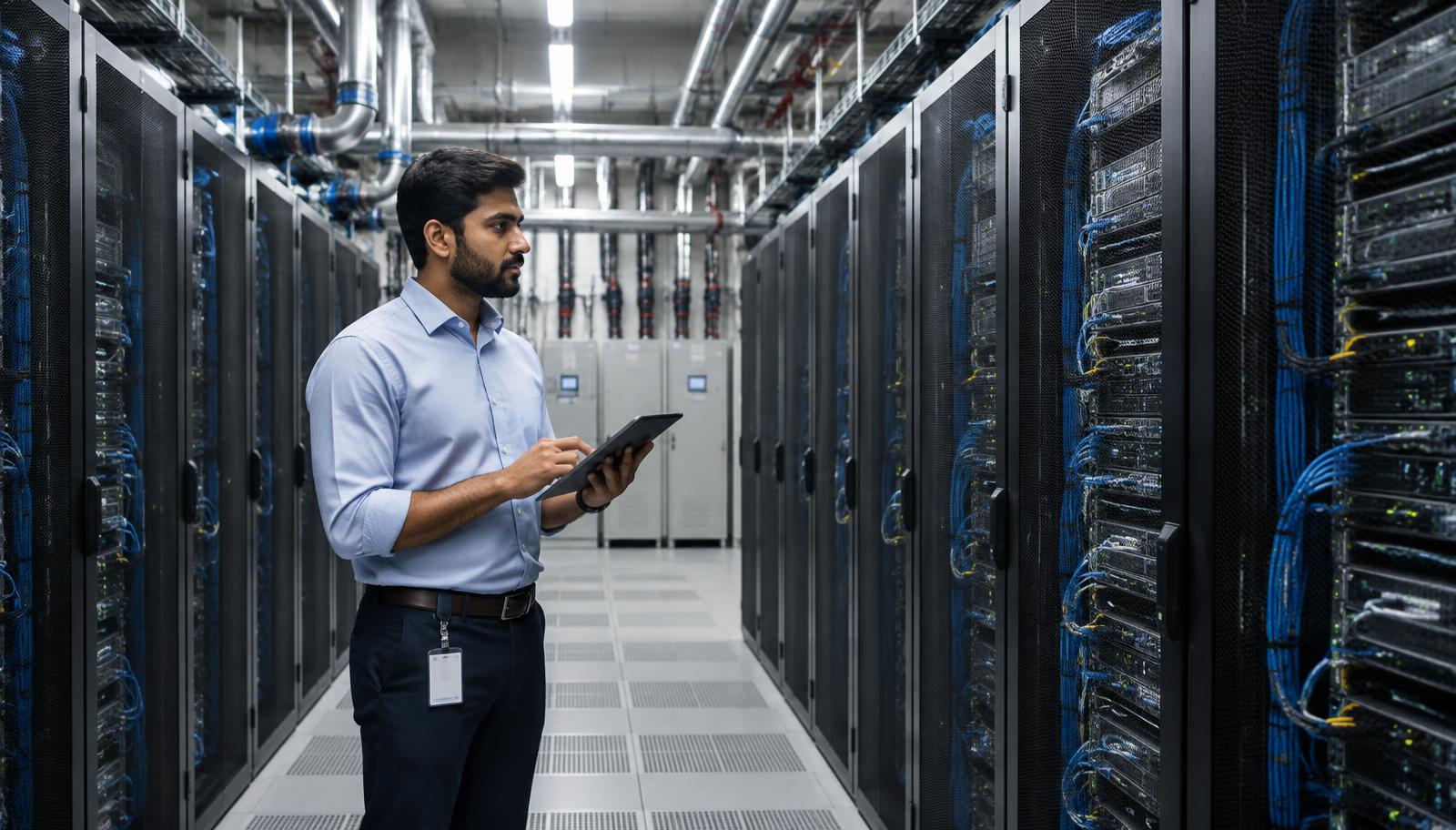
India's AI Revolution Depends on More Than Artificial Intelligence Models
When people think about artificial intelligence, they usually imagine chatbots, image generators, intelligent assistants and applications that can write code or analyse information.
However, every AI application depends on something that users rarely see: the physical infrastructure that makes it possible.
Behind an AI response are powerful processors, servers, storage systems, networking equipment, electricity supplies and cooling technologies. These components operate inside specialised facilities known as data centres.
As India's AI ecosystem expands, the demand for this infrastructure is increasing. The country is investing in computing capacity to support cloud services, enterprise AI applications, digital platforms and advanced research.
According to NITI Aayog's Data Centre Evaluation Framework released in October 2026, India's data-centre capacity has grown from approximately 375 MW in 2020 to around 1.5 GW. The framework also highlights the importance of electricity, water, connectivity and environmental sustainability in planning future infrastructure.
This development reveals an important part of the AI economy. The future of artificial intelligence will depend not only on people developing intelligent models but also on professionals who can build, operate and optimise the infrastructure supporting them.
Data Centres Are Becoming the Foundation of the AI Economy
A data centre is a specialised facility that houses computing equipment used to store, process and manage digital information.
Traditional data centres support websites, banking systems, enterprise applications, cloud platforms and digital services. AI workloads are adding another layer of demand because training and operating advanced models require substantial computing resources.
AI data centres are designed to handle demanding workloads using specialised processors such as GPUs and other AI accelerators.
These facilities bring together several interconnected technologies:
Computing infrastructure: Servers and processors that execute AI workloads. Storage systems: Technologies that store large datasets and model information. Networking: High-speed connections that allow computing systems to communicate. Power infrastructure: Electrical systems that deliver reliable energy. Cooling systems: Technologies that prevent servers and processors from overheating. Security systems: Physical and digital controls that protect infrastructure and information.
The performance of an AI application depends on how effectively these components work together.
For example, a company deploying an AI-powered customer-support platform needs more than a language model. It also requires computing resources, secure data storage, network connectivity and reliable infrastructure to serve users.
This makes data-centre development an increasingly important part of India's digital transformation.
India's Data Centre Expansion Is Creating New Infrastructure Priorities
India's growing digital economy and increasing adoption of AI are encouraging investment in data-centre infrastructure.
NITI Aayog's October 2026 framework is particularly significant because it shifts attention from attracting investment alone towards evaluating whether locations have the resources and infrastructure required to support long-term operations.
The framework examines five important areas:
- Power and energy availability.
- Water resources and cooling requirements.
- Location planning and environmental sustainability.
- Economic and strategic value.
- Policy, governance and implementation.
This approach recognises that a large data-centre investment is not automatically sustainable or beneficial for its surrounding region.
Electricity availability, water security, land use, connectivity and local infrastructure must all be considered before facilities are developed.
For India, this creates an opportunity to build an AI infrastructure ecosystem that supports technological growth while managing resource constraints.
The Energy Challenge Behind Artificial Intelligence
AI computing requires significant amounts of electricity.
Training advanced AI models involves running large numbers of calculations across specialised processors. Even after training, operating AI systems at scale requires continuous computing resources.
As AI adoption increases, data centres need reliable power supplies to maintain operations.
The challenge becomes more complex when multiple large facilities operate within the same region. Their combined electricity demand can place additional pressure on existing power infrastructure.
This creates demand for several technologies and capabilities:
Power distribution and electrical engineering. Renewable energy integration. Battery energy storage. Power management and monitoring. Energy-efficient computing. Grid infrastructure and optimisation.
For students interested in engineering and technology, this creates opportunities beyond conventional software development.
Electrical engineering, energy systems, automation, cloud infrastructure and AI computing are becoming increasingly interconnected.
Cooling Technology Is Becoming a Critical Part of AI Infrastructure
Computing equipment generates heat while processing information. As AI processors become more powerful and computing density increases, managing this heat becomes a major engineering challenge.
Data centres use specialised cooling systems to maintain suitable operating temperatures and prevent equipment failures.
Traditional air-cooling systems may become less effective for high-density AI workloads, encouraging the adoption of advanced approaches such as liquid cooling and hybrid cooling systems.
A study published by the Alliance for an Energy Efficient Economy on 27 October 2026 highlights the importance of cooling efficiency in India's data-centre expansion.
The study estimates that cooling can account for approximately 30–50% of a data centre's energy consumption. It also examines how improvements in Power Usage Effectiveness could reduce electricity requirements as infrastructure expands.
However, cooling involves an important trade-off between electricity and water consumption.
Some cooling technologies can reduce electricity requirements while increasing dependence on water. Others can reduce water consumption but require different energy and infrastructure arrangements.
This makes cooling-system design an increasingly specialised field involving mechanical engineering, thermal management, electrical systems and environmental considerations.
Sustainable AI Infrastructure Is Becoming an Important Engineering Challenge
The expansion of AI infrastructure creates economic opportunities, but it also raises environmental questions.
Data centres require electricity, water, land and supporting infrastructure. Poor planning can create additional pressure on local resources, particularly in regions already experiencing water or energy constraints.
India's NITI Aayog framework therefore recommends evaluating projects through resource availability, environmental safeguards and long-term economic value.
The Alliance for an Energy Efficient Economy also identifies several opportunities to improve data-centre sustainability:
Using efficient cooling technologies. Increasing renewable energy integration. Improving airflow and temperature management. Reusing treated wastewater where appropriate. Monitoring electricity and water consumption. Reducing equipment waste. Improving operational efficiency.
This creates a growing connection between artificial intelligence and sustainability engineering.
Professionals working in this area need to understand both the technical requirements of computing infrastructure and the environmental impact of operating it.
The future of AI infrastructure will depend on making computing more powerful without making resource consumption unnecessarily inefficient.
Emerging Technology Careers Beyond AI Model Development
One important misconception among students is that every AI career must involve developing machine learning algorithms or training large language models.
In reality, the AI ecosystem requires professionals across multiple technical disciplines.
The expansion of data centres and AI infrastructure creates opportunities in several areas.
| Career pathway | Core responsibilities | Relevant skills |
|---|---|---|
| Cloud Engineer | Managing cloud computing environments | Cloud platforms, networking, Linux |
| Data Centre Engineer | Maintaining computing infrastructure | Servers, hardware, monitoring |
| Network Engineer | Managing communication between systems | Networking, routing, security |
| Data Engineer | Building and managing data pipelines | Python, SQL, databases |
| Site Reliability Engineer | Improving system reliability and availability | Automation, monitoring, scripting |
| Infrastructure Automation Engineer | Automating infrastructure operations | Python, APIs, configuration tools |
| Cooling Systems Engineer | Designing and maintaining cooling systems | Thermal engineering, mechanical systems |
| Energy Systems Engineer | Improving energy distribution and efficiency | Electrical engineering, energy management |
These roles have different educational and technical requirements. Some require specialised engineering qualifications, while others are accessible through computer science, information technology and related technical pathways.
The important point is that AI infrastructure creates a broader technology employment ecosystem.
Skills Students Can Start Developing Today
Students interested in these emerging opportunities should begin by building strong fundamentals rather than immediately pursuing advanced specialisations.
Programming and Automation
Python is useful for automating infrastructure tasks, processing operational data and building monitoring applications.
Students should understand programming fundamentals, APIs, scripting and error handling.
Networking and Operating Systems
Understanding how computers communicate is essential for cloud and infrastructure-related careers.
Students can begin with networking fundamentals, IP addressing, DNS, Linux commands and basic system administration.
Databases and Data Engineering
AI systems depend on reliable information.
Knowledge of SQL, Python, databases, data pipelines and data validation can help students prepare for data engineering and cloud-related roles.
Cloud Computing
Students should understand how computing resources, storage, networking and applications operate within cloud environments.
They can explore introductory learning resources from AWS, Microsoft Azure and Google Cloud.
Monitoring and Automation
Modern infrastructure needs continuous monitoring.
Students can learn how to track system performance, identify failures, automate repetitive operations and generate operational reports.
Sustainability and Energy Awareness
Students pursuing engineering pathways should also understand energy efficiency, renewable energy, cooling systems and resource management.
These subjects are increasingly relevant to the development of modern computing infrastructure.
Five Practical Projects to Build an AI Infrastructure Portfolio
Students can demonstrate their understanding of these technologies through projects that combine programming, data and infrastructure concepts.
1. Data Centre Energy Monitoring Dashboard
Build a dashboard that displays electricity consumption, equipment utilisation and energy-efficiency indicators using a sample dataset.
Skills demonstrated: Python, SQL, data visualisation and analytical thinking.
2. Cloud Resource Monitoring Application
Create an application that collects resource information from an authorised cloud environment and displays CPU utilisation, memory usage and system status.
Skills demonstrated: APIs, Python, cloud fundamentals and monitoring.
3. Automated Server Health Checker
Develop a Python application that checks server availability, records system information and generates alerts when predefined conditions are met.
Skills demonstrated: Python, networking, automation and logging.
4. AI-Based Infrastructure Knowledge Assistant
Build a document-based assistant that retrieves information from technical documentation and provides source-grounded explanations about infrastructure components.
Skills demonstrated: LLM integration, RAG, document processing and APIs.
5. Cooling Efficiency Analysis Tool
Use sample operational data to compare different cooling scenarios and visualise energy and water consumption.
Skills demonstrated: Data analysis, Python, visualisation and sustainability concepts.
For every project, students should document the problem, implementation, technologies, testing process and limitations. Publishing the work through GitHub and presenting it through a professional portfolio makes the technical learning easier to evaluate.
A Practical 60-Day Learning Roadmap
| Timeline | Focus area | Expected outcome |
|---|---|---|
| Days 1–10 | Python and Linux fundamentals | Write scripts and understand basic system operations |
| Days 11–20 | Networking and operating systems | Understand how systems communicate |
| Days 21–30 | SQL, databases and data handling | Process and organise operational data |
| Days 31–40 | Cloud computing and APIs | Build a basic cloud-connected application |
| Days 41–50 | Monitoring and automation | Develop an infrastructure monitoring project |
| Days 51–60 | Project documentation and portfolio | Publish a complete technical project |
This roadmap is an introductory pathway. Students should select a specialisation based on their academic background and gradually develop deeper expertise.
Connecting Technical Learning With Career Readiness
Understanding emerging technologies becomes more valuable when students can demonstrate their knowledge through practical implementation.
This requires more than completing online tutorials. Learners need opportunities to work on meaningful projects, document their progress, maintain GitHub repositories and explain the technical decisions behind their work.
For students exploring these pathways, structured programmes such as Aiexl.'s CAIEE (Certified Artificial Intelligence Excellence Engineer) connect AI learning with practical projects, portfolio development and professional mock interviews. This approach supports the development of technical understanding alongside the ability to demonstrate and communicate practical capabilities.
As the AI ecosystem expands into cloud infrastructure, data engineering and enterprise applications, students who combine strong fundamentals with hands-on experience will be better positioned to explore different technology career pathways.
Final Takeaway: The Future of AI Depends on the Infrastructure We Build
Artificial intelligence may appear to operate entirely through software, but its growth depends on physical systems that require engineers, developers, energy specialists, data professionals and infrastructure experts.
India's expanding data-centre ecosystem creates opportunities across computing, cloud services, networking, automation, cooling and sustainable energy.
For students, this is a reminder to look beyond the most visible AI applications and understand the larger technology ecosystem.
Learning Python, SQL, cloud computing, networking and automation can open pathways into areas that support the AI economy.
The next generation of technology professionals will not only build intelligent applications. They will also develop, manage and improve the infrastructure that allows those applications to operate reliably.
The AI revolution is being built in the cloud, but its foundation is real-world engineering.
Sources and Further Reading
-
NITI Aayog — Data Centre Evaluation Framework for Sustainable Growth, October 2026
India's official framework covering infrastructure readiness, energy, water, environmental sustainability and economic value. -
NITI Aayog — Data Centre Evaluation Framework PDF
Detailed framework for planning and evaluating data-centre investments. -
Alliance for an Energy Efficient Economy — Sustainable Cooling Technologies in Data Centres, 27 October 2026
Research on cooling technologies, energy efficiency, water consumption and India's data-centre expansion. -
Indian Express — Why NITI Aayog Wants Stricter Power and Water Checks Before Approving Data Centres
Explanation of India's infrastructure planning and environmental considerations. -
McKinsey — Technology Trends Outlook 2026
Research on computing infrastructure, AI development and emerging technology trends.
Build a career in AI with CAIEE
The Certified AI Excellence Engineer programme turns these ideas into practical, portfolio-ready skills.
Explore CAIEE