AI Is Entering Indian Classrooms: Why the Next Generation Must Learn to Think Before They Learn to Use AI
Artificial intelligence is no longer limited to technology companies, research laboratories or specialised computer science courses. It is gradually becoming part of everyday education, influencing how students learn, solve problems, conduct research and develop technical skills.
Aiexl. · 02 November 2026 · 9 min read
Artificial Intelligence Is Becoming Part of the Learning Journey
Artificial intelligence is no longer limited to technology companies, research laboratories or specialised computer science courses. It is gradually becoming part of everyday education, influencing how students learn, solve problems, conduct research and develop technical skills.
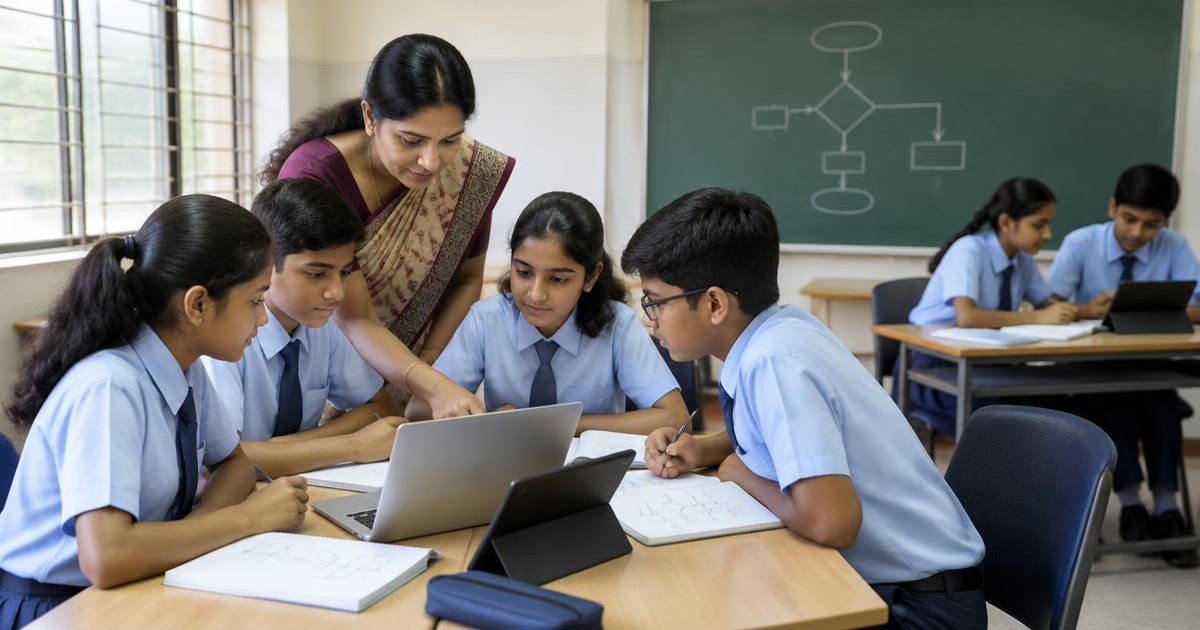
India is taking an important step in this direction. For the 2026–27 academic session, CBSE, in collaboration with NCERT, has introduced a dedicated Computational Thinking and Artificial Intelligence curriculum for students in Classes 3 to 8. The curriculum focuses on logical reasoning, pattern recognition, algorithm design, data literacy and responsible technology use.
This development represents a broader change in educational priorities. Rather than introducing students to artificial intelligence only as a collection of tools, the approach aims to develop the foundational thinking skills required to understand and work with technology.
The Ministry of Education has also highlighted the importance of teacher preparation and appropriate learning infrastructure as part of this transition.
For students, this means that familiarity with AI tools will increasingly become just one part of a much larger learning journey. The ability to understand technology, evaluate information and apply knowledge independently will matter just as much.
India's New Approach to AI Education Starts With Computational Thinking
One of the most important aspects of India's new curriculum is its emphasis on computational thinking before advanced AI concepts.
Computational thinking is a structured approach to solving problems. It involves breaking complex problems into smaller parts, recognising patterns, identifying relevant information and developing logical steps towards a solution.
These abilities form the foundation of programming, data science, machine learning and artificial intelligence.
For example, a student developing a simple attendance-management application must first understand the problem, identify the information required, establish rules and organise the process into logical steps. These are computational thinking skills, even before the student writes a line of code.
The CBSE curriculum introduces these concepts through age-appropriate activities, puzzles, exercises and problem-solving tasks. It also encourages creativity, collaboration and responsible use of technology.
This is an important distinction. Students who understand how to approach a problem are better positioned to use AI tools meaningfully than students who depend entirely on generated answers.
The curriculum is also supported by teacher handbooks and facilitator guides to help educators integrate these concepts into classroom learning.
AI Literacy Is Becoming as Important as Digital Literacy
Digital literacy traditionally involved understanding computers, using software, accessing information and communicating through digital platforms.
AI literacy builds on these capabilities. It involves understanding how AI systems work at a basic level, recognising their limitations, evaluating generated information and using AI responsibly.
A student using an AI chatbot to research a topic should be able to distinguish between reliable information and an inaccurate response. Similarly, someone using an AI image generator should understand the difference between an AI-generated visual and an authentic photograph.
AI systems can produce convincing answers even when the information is incomplete or incorrect. They can also reflect biases present in their training data and generate content that requires independent verification.
This makes critical thinking particularly important.
Students should develop the habit of checking sources, comparing information, understanding the reasoning behind an answer and taking responsibility for the work they submit.
The objective of AI literacy is not simply to make students comfortable with technology. It is to help them become informed and responsible users of it.
Teachers Will Play a Central Role in AI-Enabled Education
Introducing AI into the curriculum is only one part of educational transformation. The effectiveness of this transition will depend significantly on how teachers understand and integrate the technology into their teaching methods.
India's SOAR initiative, or Skilling for AI Readiness, includes dedicated learning modules for students and a separate 45-hour programme for educators called AI for Educators.
The initiative covers AI fundamentals, generative AI, programming concepts, ethics, cybersecurity and future career opportunities.
Teacher preparedness matters because AI should support the learning process rather than replace the educator's role.
For example, an AI tool can help teachers prepare lesson materials, create practice exercises and organise learning resources. However, understanding student difficulties, encouraging independent reasoning and providing meaningful feedback still require human judgment.
Educators also need to establish clear boundaries around AI-generated assignments, plagiarism, source verification and appropriate classroom usage.
The strongest learning environments will combine the efficiency of technology with the guidance, experience and judgment of teachers.
The Transition From School-Level AI Awareness to Professional Skills
Learning the fundamentals of AI during school education can provide students with an early advantage. However, professional applications require a much deeper understanding of technology.
A student who understands what artificial intelligence is may eventually want to explore programming, machine learning, data analytics, generative AI or AI engineering.
Each of these areas requires additional technical knowledge and practical experience.
For example, developing an AI-powered application involves understanding programming languages, APIs, databases, data processing, model integration and software development. Building a machine learning project requires knowledge of datasets, algorithms, model training and evaluation.
This is where the transition from awareness to application becomes important.
Students entering higher education should gradually move beyond using existing AI applications and begin understanding how these systems are developed, integrated and evaluated.
Structured learning pathways such as Aiexl.'s CAIEE (Certified Artificial Intelligence Excellence Engineer) reflect this progression by connecting AI concepts with practical projects, GitHub and portfolio development, and professional mock interviews. Such experiences help learners build on their technical foundations and demonstrate their capabilities through practical work.
Five Practical Ways Students Can Develop AI Skills
Students do not need to begin with advanced algorithms or complex AI applications. They can develop a strong foundation through smaller, practical activities.
1. Develop Logical Thinking Through Everyday Problems
Start by identifying everyday problems and breaking them into smaller steps.
Examples include creating a study timetable, organising personal expenses, designing a library-book tracking system or developing a simple attendance calculator.
These activities develop logical reasoning and problem decomposition.
2. Learn Programming Fundamentals
Python is a useful starting point for students interested in AI and software development.
Begin with variables, conditions, loops, functions, lists and basic data structures. Gradually move towards working with files, APIs and external libraries.
Understanding programming fundamentals makes it easier to understand how AI applications operate.
3. Explore AI Tools With a Learning Objective
Students can experiment with generative AI tools for research, coding assistance, summarisation and content creation.
However, every activity should involve independent evaluation. Compare AI-generated information with reliable sources, correct errors and understand the reasoning behind the final output.
This develops practical AI literacy rather than simple tool familiarity.
4. Build Small Projects
Practical projects help students connect concepts with implementation.
Begin with manageable applications such as a student performance tracker, a basic recommendation system, an AI-assisted research application or a simple document summariser.
As technical knowledge improves, these projects can evolve into more advanced applications involving APIs, machine learning models and automation.
5. Document and Present Your Work
Students should maintain records of their projects, including the problem being addressed, technologies used, implementation process and final outcome.
GitHub can be used to manage source code, while a portfolio website can present completed work in an organised format.
Being able to explain how a project works is an important part of demonstrating technical capability.
A Practical 90-Day Roadmap for Students Starting With AI
A structured learning plan can help students move from basic awareness towards their first meaningful AI project.
| Timeline | Learning focus | Practical outcome |
|---|---|---|
| Days 1–15 | AI fundamentals and computational thinking | Understand AI concepts and structured problem-solving |
| Days 16–30 | Python programming fundamentals | Develop small programming applications |
| Days 31–45 | Data handling and APIs | Work with structured information and external services |
| Days 46–60 | Generative AI and basic machine learning concepts | Understand how AI models can be used in applications |
| Days 61–75 | Practical project development | Build an application addressing a real problem |
| Days 76–90 | Testing, GitHub and portfolio documentation | Present a complete project with clear documentation |
Students should adapt the pace according to their existing knowledge and academic commitments. The purpose is to establish a consistent learning process rather than rush through multiple technologies.
The Future of Education Will Depend on Application, Not Just Access to AI
Making AI tools available to students is an important step, but access alone cannot create meaningful learning outcomes.
Students need opportunities to experiment, make mistakes, test ideas and develop solutions independently. Institutions need educators who understand emerging technologies, appropriate infrastructure and learning environments that encourage practical implementation.
Assessment methods will also need to evolve. Instead of evaluating students only through memorised answers, educational institutions can increasingly examine project work, practical demonstrations, problem-solving ability and the reasoning behind submitted work.
This becomes particularly important as AI tools make it easier to generate assignments, code and written responses.
The ability to explain a solution, demonstrate its implementation and defend technical decisions provides stronger evidence of genuine understanding.
India's move towards integrating computational thinking and AI into school education is an important foundation. The next challenge will be connecting this early exposure with deeper technical learning, higher education and professional opportunities.
Final Takeaway: Learn to Think, Build and Apply
Artificial intelligence is changing the knowledge and skills students will need throughout their education and professional lives.
Learning how to use AI tools is useful, but developing logical thinking, technical understanding, creativity and problem-solving ability will provide a much stronger foundation.
Students who begin building these capabilities early can gradually progress from understanding AI to developing applications and solving real-world problems.
The future of AI education should not be measured only by how many students have access to AI tools. It should also be measured by how confidently they can think independently, use technology responsibly and turn their knowledge into practical solutions.
The real advantage will belong to students who understand the technology well enough to create something meaningful with it.
Sources and Further Reading
- Ministry of Education, Government of India — Artificial Intelligence and Digital Education in Government Schools — Official details on the 2026–27 curriculum and AI education initiatives.
- CBSE — Computational Thinking and Artificial Intelligence Curriculum — Student and teacher learning resources for Classes 3 to 8.
- CBSE — Curriculum Framework for Computational Thinking and AI — Curriculum foundations and learning objectives.
- Ministry of Skill Development and Entrepreneurship — SOAR Programme — National AI-readiness learning initiative for students and educators.
- The Indian Express — CBSE makes AI a part of formal teaching — Developments in formal AI education and curriculum implementation.