Indian banks are moving AI from experiments into production
AI is starting to change how complex business operations actually run.
Aiexl. · 12 October 2026 · 2 min read
What happened?
An interview published by Express Computer on 12 October discussed how India’s banking and financial-services industry is progressing from AI proof-of-concept projects to systems used in operational workflows.
Kishan Sundar, CTO of Maveric Systems, described deployments involving anti-money-laundering investigations, customer-service assistance, software testing and modernisation of older applications.
One example involved an agent-based anti-money-laundering workflow at a regional North American bank. Different levels of the process had different degrees of autonomy: some tasks were automated, while more complex work retained human involvement.
In another example, an AI-assisted customer-service system reportedly improved its ability to identify a customer’s reason for calling from 75% to 90% accuracy across approximately ten user journeys. The same implementation reportedly reduced call-closure time from around 15 minutes to less than five minutes. These are figures reported by the interviewee for a particular deployment, not independently audited results or an industry-wide benchmark.
What changed between a pilot and production?
A demonstration can show that a model answers a question. A production system must also work with organisational data, follow internal policies, protect sensitive information and provide consistent results.
The interview identified several important challenges:
- Context: A bank’s procedures and customer records must inform the model’s response.
- Cost: Frequent model calls and large prompts can make applications expensive to operate.
- Consistency: A useful response must follow the organisation’s actual rules, not just general knowledge.
- Human oversight: Staff need to understand and review important recommendations.
- Legacy systems: Older software must be understood and modernised without disrupting critical operations.
The interview also described AI-assisted application modernisation, including migration from older frameworks and technologies. The claimed reduction of some programmes from around a year to roughly three months is an industry practitioner’s estimate, not a universal delivery guarantee.
What this means for aspiring developers
The opportunity is to become comfortable with the full application lifecycle rather than focusing exclusively on model selection.
Learn to retrieve relevant information, connect applications to APIs and databases, evaluate outputs, test failure scenarios and measure whether a system improves the process it was designed to support.
Practical project idea: Build an AI knowledge assistant that answers questions from a set of policy documents. Make it cite the relevant passages, reject unsupported questions, record failed responses and compare its accuracy before and after improvements.
The Aiexl. perspective
A working AI demo is easy to show. Can your application handle real users, real data and real mistakes?
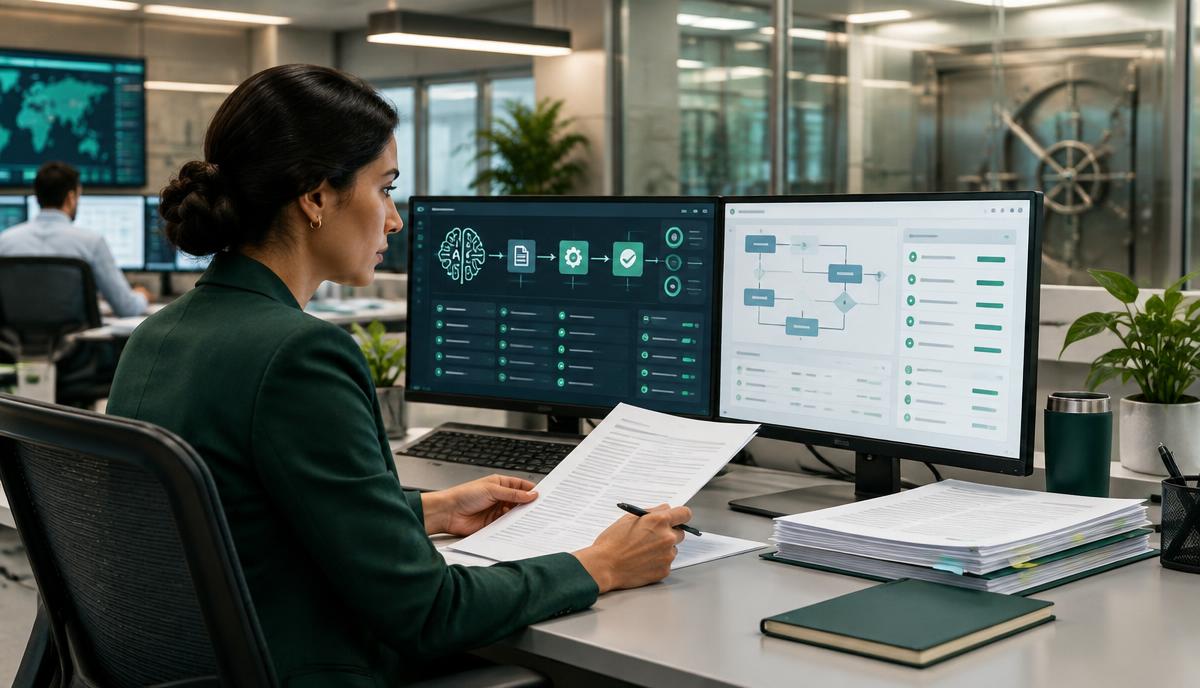
Cover: AI-generated editorial illustration, not a photograph of the reported deployments.
Sources & references
Build a career in AI with CAIEE
The Certified AI Excellence Engineer programme turns these ideas into practical, portfolio-ready skills.
Explore CAIEE