
India’s startup ecosystem is being encouraged to go global, while AI research remains a concern
India’s next technology opportunity may depend on building original products, not just services.
Aiexl. · 12 October 2026 · 2 min read
What happened?
At the ET Startup Awards 2026 in Bengaluru, Commerce and Industry Minister Piyush Goyal encouraged Indian startups to expand beyond the domestic market. He said the government was willing to support their participation in international exhibitions and conferences to help them reach new markets and attract investors.
The same event featured a warning from Times Internet chairman Satyan Gajwani about India’s relative position in AI. He argued that India needs deeper research, more computing power and patient capital to compete more effectively with the United States and China. He also highlighted the growing interest of Indian founders in deep technology, including semiconductors, AI robotics, clean energy and advanced materials.
These are statements made at an industry event, not a newly announced nationwide funding guarantee or evidence that India has already closed its AI research gap.
Why does this matter?
India has a large technology-services industry, but developing globally competitive technology products presents a different challenge.
A services company may generate revenue by helping customers implement existing technology. A deep-tech startup may need years of research, specialised equipment, expensive computing resources and repeated experimentation before its product becomes commercially viable.
This creates two distinct but complementary opportunities:
- Applied AI: Building useful applications with existing models and infrastructure.
- Deep technology: Developing original models, algorithms, hardware or scientific capabilities.
Neither path is automatically superior. Applied AI can solve valuable problems without training a foundation model from scratch, while deep technology can create defensible capabilities but usually carries higher research and capital requirements.
What this means for students
Students interested in startups should learn to identify a specific problem before selecting a technology.
For example, instead of building a generic AI chatbot, a student might investigate how a small manufacturer tracks quality issues or how a college placement cell manages employer information. The best project would demonstrate a real workflow, measurable usefulness and a clear explanation of limitations.
Those interested in research-heavy roles should also strengthen mathematics, programming, data structures, statistics and experimental methodology.
The Aiexl. perspective
India doesn’t just need more people using AI. It needs people who can build useful technology and solve problems worth paying for.
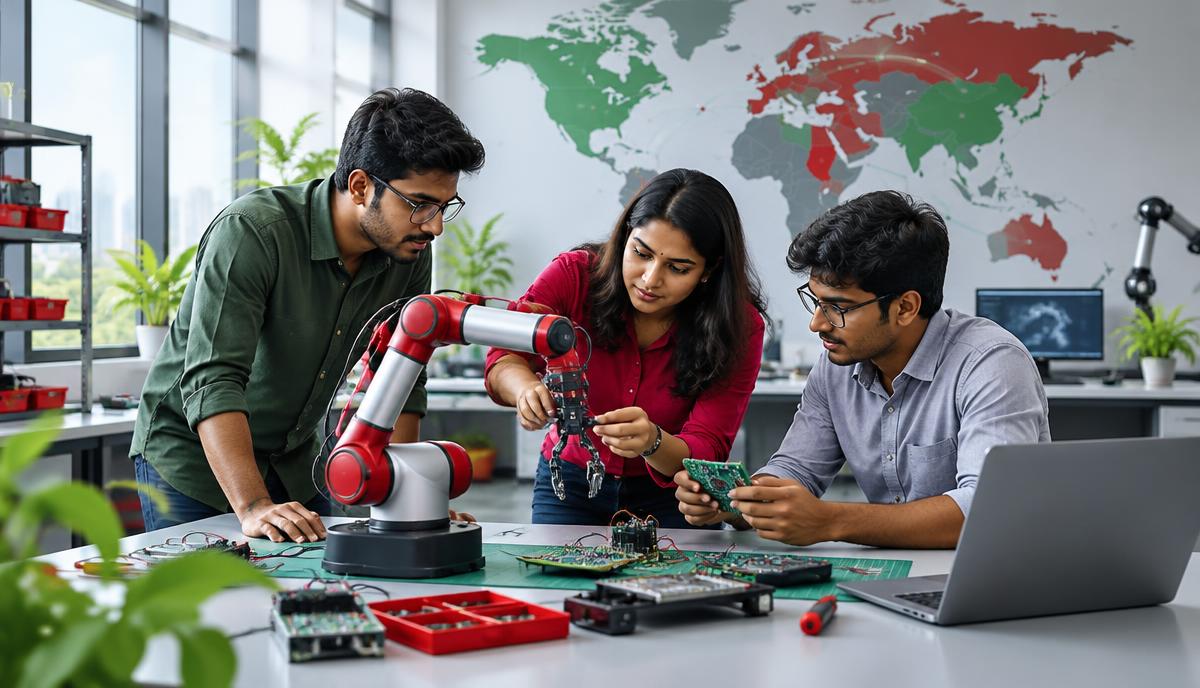
Cover: AI-generated editorial illustration, not a photograph of the event or its participants.
Sources & references
Build a career in AI with CAIEE
The Certified AI Excellence Engineer programme turns these ideas into practical, portfolio-ready skills.
Explore CAIEE